Five Years of Platforma Klio
From an informal initiative connecting educators to an internationally networked association dedicated to improving history education

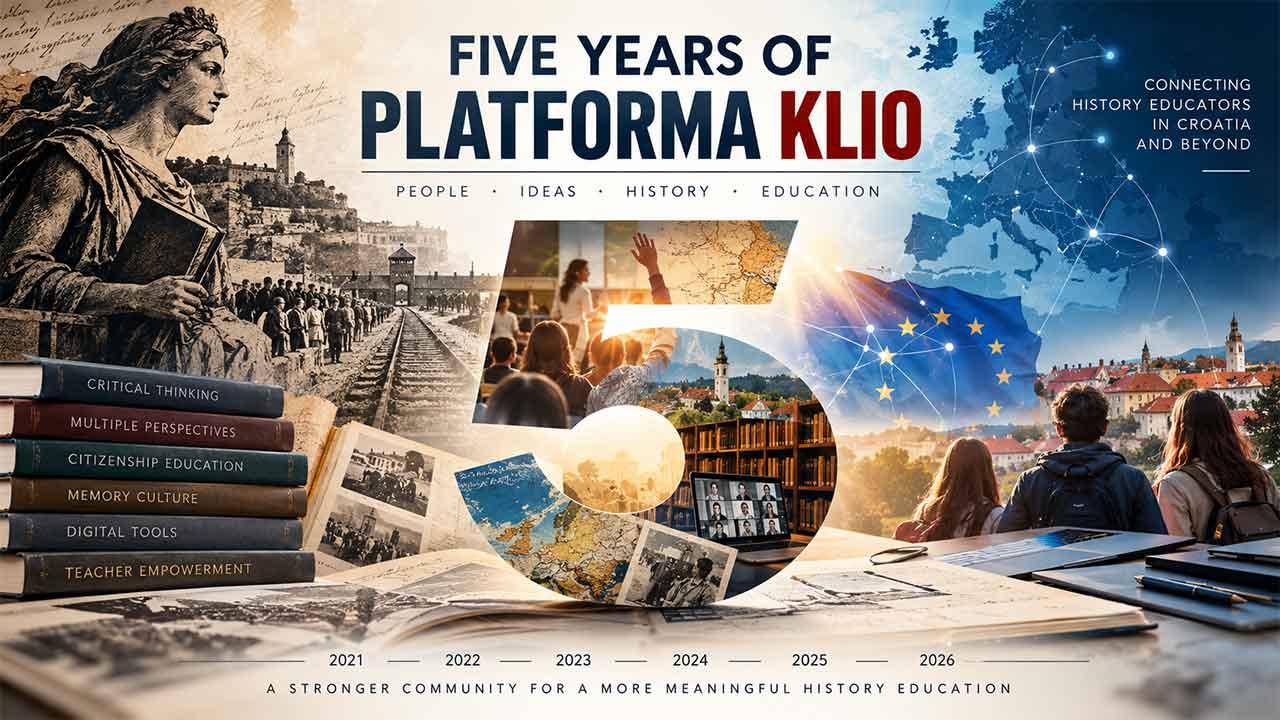
In 2026, Platforma Klio celebrates five years of activity. Launched in 2021 as an informal interdisciplinary project with an international outlook, it has developed over the past five years into a non-profit association bringing together history teachers, researchers, authors of educational materials, and other educators committed to improving history education.
At the heart of Platforma Klio’s work is the belief that history education should not be limited to the acquisition of factual knowledge about the past. It should develop students’ abilities to investigate, analyse, and interpret historical sources, understand different perspectives, and critically examine historical narratives. This approach connects history education with civic education, human rights, democratic culture, and digital literacy.
Over the past five years, these principles have been put into practice through publishing, webinars, virtual roundtables, research into history education, professional development activities, international cooperation, and the development of digital educational tools.
2021 – The Beginning of the Initiative
Platforma Klio began its activities in 2021 with the aim of connecting professionals who shared an interest in contemporary approaches to history education. From the outset, it was conceived as an open community in which teachers, academics, museum professionals, and other interested individuals could collaborate.
One of its first publicly documented activities took place on 28 December 2021, during an online meeting of the County Professional Council for Civic Education in Brod-Posavina County. Miljenko Hajdarović, then coordinator of the project, delivered a lecture entitled “Historical Vocabulary in Everyday Life During the Pandemic.” The lecture examined the historical context of terms such as totalitarianism, dictatorship, segregation, discrimination, and ghetto, which had become increasingly common in public debates during the COVID-19 pandemic. This early activity already highlighted one of the characteristics that would define Platforma Klio’s future work: connecting historical knowledge with an understanding of contemporary social developments.
2022 – The First Training Activities and the Launch of a Professional Journal
During 2022, Platforma Klio developed a programme of online professional lectures and laid the foundations for long-term publishing activities by launching the journal Poučavanje Povijesti (Teaching History).
Professional Lectures on History and Contemporary Social Issues
Among its first educational activities was the lecture “Silk, Dragons and Paper,” delivered by Goran Đurđević on 23 February 2022. The lecture explored Chinese civilisation, culture, archaeology, and history, combining the popularisation of historical scholarship with professional development.
Shortly after the beginning of Russia’s full-scale invasion of Ukraine, a webinar entitled “Contemporary Ukrainian-Russian Relations” was held on 5 April 2022. Miljenko Hajdarović examined the historical background of relations between Ukraine and Russia, the development of Ukrainian national identity, and the use of historical arguments to justify the war. The webinar raised questions that had become particularly important for teaching contemporary history: how to distinguish historically grounded arguments from propaganda, how to recognise the manipulation of historical narratives, and how to explain contemporary conflicts to students within their broader historical contexts.
Webinar on Ukrainian-Russian relations
Launch of the Journal Poučavanje Povijesti
On 1 June 2022, the first issue of the professional journal Poučavanje Povijesti was presented to the public. The online launch featured editorial board members Goran Đurđević, Denis Detling, and editor Miljenko Hajdarović, alongside messages from Tatjana Bednjanec, Manuela Kujundžić, and Tomislav Bogdanović.
The journal was conceived as a publication in which teachers could write for fellow teachers, share classroom experiences, and present the results of professional reflection and research. At the same time, it provided a platform for contributors from historical scholarship and other disciplines related to education.
The second issue was published in December 2022. One of its notable contributions was “An Analysis of the State of History Education in Croatia” by Miljenko Hajdarović, based on survey responses from history teachers. The research enabled a comparison of responses collected in 2021 and 2022. The first survey involved 280 respondents, while the second included 188. The analysis addressed curriculum issues, teaching materials, professional development, and the position of History within the Croatian school system.
Thus, already in its first year of publication, the journal provided a space not only for sharing good practice but also for critically examining educational policies.
Analysis of the state of history education in Croatia
2023 – Professional Debates, Artificial Intelligence, and the Establishment of the Association
The year 2023 marked an important turning point. Platforma Klio launched several thematic discussions, expanded its professional development activities, strengthened international contacts, and evolved from an informal initiative into a registered non-profit association.
What Do We (Not) Need in History Education?
In April 2023, Platforma Klio launched “What Do We (Not) Need in History Education?”, a project designed to encourage ongoing discussion about the selection of historical content in primary education. The project’s central question was straightforward but significant: what do students really need to learn in History, how much detail should be devoted to particular topics, and how can factual knowledge be balanced with the development of historical thinking?
Four discussions were held during the first season: an introductory roundtable on the project’s objectives, a discussion on Introduction to History featuring Neven Budak, a discussion on Prehistory with Rajna Šošić-Klindžić, and a discussion on Early Civilisations with Goran Đurđević and Mladen Tomorad. The discussions brought together practising teachers and university scholars. Recordings were made publicly available, enabling a wider audience to engage with the debate afterwards.
The project also represented an attempt to establish a more systematic dialogue about history curriculum content, an area in which teachers often have limited direct influence during educational reforms.
Project information and discussion archive
Teaching History in the Age of Artificial Intelligence
As part of the Kliofest History Festival, Platforma Klio organised a virtual roundtable entitled “Teaching History in the Age of Artificial Intelligence” on 17 May 2023. Participants included science journalist Nenad Jarić Dauenhauer, university lecturer Benedikt Perak, and Miljenko Hajdarović. The discussion explored the development of generative artificial intelligence, its potential applications in historical research and education, changes in the role of teachers, and questions concerning the reliability of AI-generated content.
This event marked one of Platforma Klio’s first public contributions to a subject that would become an increasingly important part of its work in subsequent years.
Establishment of the Platforma Klio Association
The founding assembly was held on 27 July 2023, and the association’s registration in the Register of Associations of the Republic of Croatia was announced on 13 October of the same year.
The founding members were Miljenko Hajdarović, Goran Đurđević, Anita Škvorc Branda, Manuela Kujundžić, Denis Detling, Kristina Lukec, Maja Lukić Puškarić, Helena Jilek Kubalek, Valentina Milohanić, Tomislav Bogdanović, and Luka Vrljić. Miljenko Hajdarović was elected President, Manuela Kujundžić Vice-President, and Maja Lukić Puškarić, Helena Jilek Kubalek, and Tomislav Bogdanović were also elected to the Executive Board.
Formal establishment as an association enabled more systematic membership development, the organisation of professional training, stronger partnerships, and the preparation of international projects.
Report on the establishment of the association
Digital Tools, International Issues, and Remembrance Culture
In September 2023, Helena Jilek Kubalek delivered a webinar entitled “eTwinning and History.” The session introduced opportunities for international school projects, the use of the European School Education Platform, and experiences of connecting students from different schools. A project designed to support learning about eTwinning was subsequently launched.
Recording of the eTwinning and History webinar
In October, a public discussion about Platforma Klio’s future plans was held, presenting its achievements, upcoming training programme, and opportunities for members to become more actively involved.
On 14 November, Platforma Klio collaborated with the HERMES association to organise an online presentation of the graphic novel “Lea’s Story,” which tells the story of Lea Deutsch, a young actress from Zagreb who became a victim of the Holocaust. Ida Ljubić and Tvrtko Pater participated in the event. The activity connected history education, remembrance culture, and the use of graphic novels as teaching resources.
On 21 November, a workshop on the digital tool Sutori was held, led by Miljenko Hajdarović. Participants explored the possibilities of creating interactive timelines and digital historical narratives and applying the tool in history lessons.
Remembering Vukovar
On 29 November 2023, Platforma Klio organised a virtual roundtable entitled “Remembering Vukovar and the Values of the Croatian War of Independence in History Education.” The participants were Predrag Fred Matić, Tamara Mazur, Silvija Švelinger, and Ivana Kričkić. The discussion addressed the role of memorial sites, field trips, the transmission of experiences and values associated with the Croatian War of Independence, and the challenges of teaching recent history and remembrance culture.
Recording of the Vukovar discussion
International Discussions on Contemporary Conflicts
During 2023, an activity dedicated to Israeli-Palestinian relations was also held, connected with cooperation with the Embassy of the State of Israel. Such discussions formed part of Platforma Klio’s efforts to make complex and sensitive topics in contemporary history more accessible to teachers and the wider public.
The fourth issue of Poučavanje Povijesti, published in December 2023, also featured an interview with the Ambassador of the State of Israel, conducted by Nataša Ilić Agatić.
On 4 December 2023, Platforma Klio organised two lectures on Ukrainian history and the contemporary war. Dr Maryna Bessonova delivered a lecture entitled “Memory Wars: Russia vs Ukraine,” examining different interpretations of historical events in Russian and Ukrainian historiography and their use in the contemporary information conflict. Dr Kateryna Shymkevych discussed historical falsifications and misconceptions about Ukraine in Russian propaganda, particularly the instrumentalisation of history to challenge Ukrainian identity and sovereignty.
Lectures on Ukraine – recording and additional information
International Professional Development and Exchange of Experience
Members and collaborators of Platforma Klio also participated in international professional activities during 2023, which were subsequently presented in the journal Poučavanje Povijesti. Maja Lukić Puškarić attended the seventh European seminar “Holocaust by Bullets,” held in Budapest from 21 to 23 September 2023 and organised by Yahad-In Unum and the Hungarian Holocaust Memorial Center. She shared her experiences and the seminar’s content in a professional report. The journal also published a report by Tatjana Protulipac on the Forum on History and Remembrance Education in the Post-Yugoslav Region, held in Pula from 20 to 22 October 2023, with support from EUROCLIO and the Evans Foundation.
Such participation and reports enabled the transfer of international experiences to the broader community of Croatian history teachers.
Encouraging Professional Writing
During 2023, Platforma Klio also organised an award for the best professional articles published in the first volume of Poučavanje Povijesti. The award went to “HiSTEMory – Unlimited Opportunities for Integrating History and Mathematics,” by Jelena Červenjak Kmoniček and Anita Čorak. This initiative aimed to further encourage teachers to document classroom practice, engage in interdisciplinary cooperation, and contribute to professional publications.
2024 – Holocaust Education and Digital Transformation
During 2024, Platforma Klio continued its publishing and professional development activities, placing particular emphasis on Holocaust education and the use of digital technologies.
The First Holocaust Education Week
In January, Platforma Klio organised its first Holocaust Education Week, marking International Holocaust Remembrance Day. The programme included five lectures. On 22 January, Kristina Dilica discussed the use of literary works in Holocaust education. On 23 January, Nikola Aleksić delivered a lecture entitled “My Grandfather – the Last Nazi Concentration Camp Prisoner,” and on 24 January, Miljenko Hajdarović gave an introductory lecture entitled “What Is the Holocaust?” On 25 January, Maja Lukić Puškarić, Marija Krstinić, Jelena Červenjak Kmoniček, Anita Čorak, and Maja Šimić presented examples of classroom practice. The programme concluded on 29 January with Miljenko Hajdarović’s lecture “Digital Sources for Teaching about the Holocaust.”
The first Holocaust Education Week brought together historical knowledge, personal experiences, literature, classroom practice, and the use of digitised sources. It offered teachers different approaches to addressing one of the most sensitive topics in contemporary history.
Historiana and Digital Tools for History Education
On 27 March 2024, a webinar was held on Historiana and its eActivity Builder, a tool designed for creating interactive learning activities based on historical sources. Historiana, developed by an international network of educators associated with EUROCLIO, provides teachers with access to historical content, ready-made learning activities, and tools for independently developing digital educational materials.
The webinar was part of Platforma Klio’s efforts to introduce European educational resources to Croatian teachers and encourage their use in history lessons.
Artificial Intelligence in History Education
During Kliofest 2024, Miljenko Hajdarović participated as a representative of Platforma Klio with a lecture entitled “The Potential and Limitations of Artificial Intelligence in History Education.” The topic continued the discussion initiated the previous year, particularly concerning the reliability of AI-generated content, its potential classroom applications, and the development of historical thinking.
On 19 November 2024, an internationally oriented English-language webinar entitled “Exploring Potential Digital Technologies for History Education” was held, led by Miljenko Hajdarović. The webinar presented research findings on technological changes in history education, including the potential of generative artificial intelligence, augmented reality, language technologies, mobile communication systems, and gamification. Particular attention was given to futures research methods, such as technology forecasting, the Futures Wheel method, and the Delphi method, as well as potential challenges related to digital literacy, data protection, and the ethical use of technology.
Exploring Potential Digital Technologies for History Education
These activities confirmed that Platforma Klio views artificial intelligence not merely as a technical tool but also as a subject of research into possible changes in history teaching and learning.
2025 – European Networking and the Expansion of Professional Programmes
The year 2025 was characterised by a stronger international position for the association, an expanded professional development programme, continued publishing activities, and the launch of new digital educational services.
Training in Psychology and Mental Health
On 21 January 2025, the new training season opened with a lecture entitled “Supporting Students’ Mental Health.” The speaker, Berta Bacinger Klobučarić, a clinical psychologist at the Public Health Institute of Međimurje County, discussed how to recognise psychological difficulties among students, distinguish developmentally typical behaviour from mental health concerns, and provide emotional support. The professional development programme also included psychological counselling sessions for history teachers.
The Second Holocaust Education Week
The second Holocaust Education Week was held in January 2025, organised by Platforma Klio and Clionaut Academy. The programme included four lectures.
- Sanja Petrović Todosijević discussed the Holocaust in German-occupied Serbia between 1941 and 1945.
- Miljenko Hajdarović delivered two lectures: “The Holocaust: Myths, Misconceptions and Denial” and “The Holocaust: Voices of Survivors and Documents of Horror.”
- Berta Bacinger Klobučarić delivered a lecture entitled “Survivor’s Guilt,” connecting the historical experiences of survivors with the psychological consequences of extreme violence and persecution.
The second edition further developed the interdisciplinary approach, particularly by connecting history, psychology, authentic testimonies, and the critical understanding of Holocaust-related misinformation.
Report on the second Holocaust Education Week
Europeana and Changing Democracies
In February, Ivana Štiglec delivered a training session entitled “Europeana Resources in Education,” focusing on the use of Europe’s digitised cultural heritage in teaching and learning. On 6 March 2025, Platforma Klio and the Museum of Slavonia organised an online presentation of the international project Changing Democracies. Speakers Denis Detling and Jelena Batrnek presented the project’s results, experiences of democratic transitions in Europe, and educational resources developed for young people. The project explored memories of life under non-democratic systems, transitions to democracy, and the potential of history education to strengthen democratic citizenship.
Full Membership in EUROCLIO
In April 2025, Platforma Klio became a full member of EUROCLIO, the European Association of History Educators. Its admission was confirmed at EUROCLIO’s General Assembly in Bratislava. At the time of its application, Platforma Klio reported 49 members. EUROCLIO membership created additional opportunities to connect with European associations, exchange teaching experiences, participate in international professional activities, and develop joint projects.
Platforma Klio supports the principles of the EUROCLIO Manifesto, particularly high-quality history education, multiperspectivity, education for democratic citizenship, and heritage education.
Publishing, Membership, and Organisational Development
The association’s third regular General Assembly was held on 3 July 2025. The meeting reviewed the organisation’s achievements, including the publication of the sixth issue of Poučavanje Povijesti. Across its first six issues, the journal had featured contributions from 94 authors from Croatia and abroad.
Communication with members continued through newsletters, while teachers were encouraged to take a more active role in designing and delivering professional development activities.
In July, an open call entitled “The Strength of Professional Cooperation” was published, encouraging teachers and other educators to share their expertise and classroom experiences with colleagues through lectures, workshops, and other forms of professional development.
Centre for Digital Learning and Professional Development
During 2025, the Centre for Digital Learning and Professional Development (CDUU) began providing services to users. It was developed through cooperation between Platforma Klio and the Inter nos business. CDUU was established as a digital environment for professional development, online lectures, structured courses, and other forms of lifelong learning. The cooperation combines the association’s educational content and professional expertise with the technical infrastructure and experience of Inter nos.
This created an additional organisational and technological foundation for developing more accessible forms of professional learning.
Centre for Digital Learning and Professional Development
Mein Kampf – A Century of the Book That Foreshadowed Genocide
On 4 September 2025, an online lecture entitled “Mein Kampf – A Century of the Book That Foreshadowed Genocide” was held, marking the centenary of the publication of the first volume of Hitler’s political work. The lecture was intended for teachers of History, Civic Education, and Ethics, as well as the wider interested public.
The topic provided an opportunity for historical and critical analysis of the development of Nazi ideology, political extremism, propaganda, and antisemitism, with particular emphasis on the responsible teaching of historical texts that served to justify persecution and mass violence.
2026 – Digital Tools, International Networking, and a New Direction for Development
During 2026, Platforma Klio continued organising professional development activities while increasingly focusing on developing its own digital tools, strengthening international networks, and researching the professional needs of history teachers.
Organisational Development
At its meeting on 26 January 2026, the Executive Board adopted decisions to increase the annual membership fee to €15, introduce future publishing conditions for the journal, and support the preparation of international project proposals. Two professional directions for international development were highlighted: improving Holocaust education in the context of artificial intelligence and developing the digital competencies of history teachers.
Report on the Executive Board meeting
Digital Manufactory – Artificial Intelligence in History Education
In early September 2026, a lecture and workshop entitled “Digital Manufactory – Theory and Practice: Using AI in History Education” were held as part of professional development activities for history teachers in Split-Dalmatia County. Later that month, a public webinar on the same topic was delivered by Miljenko Hajdarović. The training activities focused on the responsible use of generative artificial intelligence, checking the reliability of AI-generated content, designing high-quality learning activities, and preserving student authorship. Particular attention was given to the difference between producing educational materials quickly and genuinely improving the quality of teaching. Artificial intelligence can be a useful tool, but professional judgement, historical thinking, and pedagogical decisions must remain the responsibility of teachers.
A recording of the public webinar was published on YouTube and the Croatian History Portal.
Recording of Digital Manufactory
Participation in the International NECE Lab in Salzburg
From 16 to 18 September 2026, Miljenko Hajdarović participated in the international NECE Lab on AI and the Future of Historical Learning, held at the University of Salzburg. The event brought together experts from fifteen European countries. Miljenko Hajdarović participated as a Croatian researcher focusing on the future of history education and associated with Platforma Klio. The three-day programme focused on artificial intelligence, historical consciousness, remembrance culture, and ethical questions surrounding the use of AI-generated historical content. Discussions explored the potential of AI-generated reconstructions, digital testimonies, and historical personas, alongside the risks of historical inaccuracies, bias, manipulation, and the blurring of boundaries between sources and interpretations.
Participation provided opportunities to connect with researchers, teachers, museum and memorial professionals, and representatives of European civil society organisations.
Report on NECE Lab in Salzburg
A Hungarian Perspective on Mohács
On 21 September 2026, Platforma Klio organised a webinar exploring the Hungarian perspective on the Battle of Mohács, marking the 500th anniversary of the battle in 1526. The speaker, Denis Njari from the Faculty of Humanities and Social Sciences in Osijek, presented recent historiographical and bioarchaeological research, alongside the development of Mohács as an important site of Hungarian historical remembrance.
The event continued Platforma Klio’s commitment to promoting multiperspectival approaches to shared Central European history.
Strengthening Cooperation with Hungary’s TTE
In October 2026, cooperation with the Hungarian History Teachers’ Association, Történelemtanárok Egylete (TTE), was further strengthened. A meeting held in Budapest on 11 October 2026 brought together Miljenko Hajdarović and TTE representatives Balázs Bárány and Péter Szász. Discussions focused on the exchange of experiences, joint professional activities, and opportunities for developing longer-term connections between Croatian, Hungarian, and other European history teachers.
Particular attention was given to joint research activities concerning digital practices and the professional needs of history teachers, in cooperation with Hungary’s TTE and Serbia’s Association for Social History EUROCLIO.
Report on the meeting with TTE
Klio Assessment – Developing Our Own Digital Tool
On 18 October 2026, Platforma Klio invited history teachers to test a new web application called Klio Vrednovanje (Klio Assessment). The tool is designed to help teachers prepare descriptive notes on student achievement for Croatia’s electronic school register, e-Dnevnik. Suggested notes are generated on the basis of curriculum learning outcomes, assessment criteria, and observed student achievements. The initial version is intended for Grade 5 of primary school, with expansion to Grades 6, 7, and 8 planned after testing.
The project’s particular value lies in its aim to address the practical needs of teachers and to develop the tool through their experiences and feedback.
Five Years of Publishing, Research, and Building a Community of Educators
One of Platforma Klio’s most important lasting achievements is the professional journal Poučavanje Povijesti (ISSN 2939-2373). Since 2022, the journal has provided a platform for professional and research articles, classroom practice, analyses of educational policies, book reviews, reports from training events, and other contributions aimed at improving history education. Published in open access, its issues are available through the Croatian History Portal and Hrčak, the Croatian portal of scientific and professional journals. Numerous authors from Croatia and abroad have contributed to its development, including teachers, academics, museum professionals, and representatives of various educational organisations.
The journal also serves as a record of the professional development of this community. In addition to methodological and research articles, it regularly publishes reports from national and international training events, interviews with experts, and examples of innovative teaching approaches.
The journal is jointly published by Platforma Klio and Inter nos.
The Croatian History Portal (Hrvatski povijesni portal) also plays an important role in communication with the professional community. Established in 2005, long before Platforma Klio was founded, the portal has developed into a shared digital environment for publishing news about the association, historical articles, primary sources, digital educational resources, and training materials. Its existing readership helps increase the visibility of Platforma Klio’s activities in Croatia and internationally.
Alongside the Croatian History Portal and the journal, Platforma Klio’s activities include publishing recordings of lectures, sharing educational resources, informing the teaching community about professional development opportunities, and connecting teachers who wish to share their experiences and expertise with others.
Upcoming Activities for the 2026/2027 School Year
Platforma Klio will continue organising professional webinars and lectures featuring Croatian and international speakers. The programme announced so far includes:
- A Comparative Analysis of Fascism and the Ustaša Movement, 1929–1939 – Ivan Podnar (5 November 2026).
- Jasenovac in Holocaust Education: What Do Students See in Croatian History Textbooks? – Miljenko Hajdarović (21 January 2027).
- Lecture by Dragana Stojanović – Dragana Stojanović, Haver Serbia (25 January 2027; the topic will be announced later).
- The Holocaust – Teaching Through Local History Examples – examples of classroom practice presented by Croatian history teachers (26 January 2027; speakers will be announced later).
- Auschwitz – An Educational Travelogue – Miljenko Hajdarović (27 January 2027).
- The Holocaust: Myths, Misconceptions and Denial – Miljenko Hajdarović (29 January 2027).
- Can History Be Taught Without a National Narrative? – Karel Van Nieuwenhuyse, Belgium (17 February 2027).
- Trieste Is (Not) Ours – Federico Tenca Montini, Italy (April 2027; the exact date will be confirmed).
Detailed descriptions, schedules, registration information, and any subsequent programme changes are regularly published in the Platforma Klio Events Calendar.
The Next Five Years – From a Professional Initiative to Project Implementation
Five years of Platforma Klio demonstrate how a community built around a professional initiative can gradually develop into an organisation connecting education, research, publishing, digital technologies, and international cooperation.
The first five years were a period of laying the foundations: building a professional community, launching a journal, organising training activities, shaping the association’s identity, and establishing national and international contacts. These foundations now make the next major stage of development possible.
Over the next five years, Platforma Klio is taking major steps towards preparing and implementing local, regional, national, and international projects. The aim is to transform the experience gained so far, the professional network, and the educational approaches developed into concrete, longer-term, and sustainable activities with tangible results.
At the local and regional levels, particular emphasis will be placed on researching and teaching local history, cooperating with schools, museums, cultural institutions, and local communities, and involving students, university students, and teachers in research and educational projects. The historical and cultural heritage of Međimurje provides particularly valuable opportunities for developing new forms of experiential, field-based, and interdisciplinary learning.
At the national level, Platforma Klio aims to contribute further to the professional development of history teachers, research into actual classroom practices, the development of teaching materials and digital tools, and professional discussions about the future of history education. It is particularly important to empower teachers to become not merely users of educational content and implementers of curricula, but active participants in their development, research, and critical evaluation.
At the international level, EUROCLIO membership and cooperation with partner organisations provide a foundation for participation in European educational and research projects. Key areas of interest remain Holocaust and remembrance education, the development of historical and critical thinking, democratic citizenship, educators’ digital competencies, and the responsible use of artificial intelligence. The association will seek to take on active project roles, develop its own project proposals, and contribute to international partnerships through its professional, methodological, and technical expertise.
Strengthening the association itself will also be an important part of this development: expanding membership, involving new experts and volunteers, developing working groups, and creating the conditions for the sustainable implementation of increasingly ambitious projects. Platforma Klio intends to remain an open community in which diverse knowledge and experiences are brought together through collaborative work.
Our goal is for Platforma Klio to become an even stronger centre for cooperation, innovation, and professional development in history education over the next five years – connecting local classrooms and heritage sites with international educational and research networks.
Join Platforma Klio!
The association’s development depends on people who are willing to share their knowledge, experiences, and ideas. We invite teachers, academics, university students, museum professionals, other educators, and everyone interested in improving history education to join us.
By becoming a member, you can support our ongoing work, participate in professional activities, contribute to the development of new projects, and help shape the future of Platforma Klio.
Become part of our community and work with us to improve history education.
Information about membership, benefits, and the online application form is available at Join Platforma Klio.